Job search
How I tried to clean up my LinkedIn and doubled the problem
I posted a fake dream job to thin out the wrong connections. Requests went up, CVs arrived, and people tagged friends under the post explaining there was no job.
7 min read
Audio edition is being recorded
I thought I was cleaning up a small LinkedIn problem. Instead, I accidentally made the whole thing much worse.
A few days ago I launched Career OS.
The way I work is fairly simple in theory: I build the candidate profile first, then I search for jobs around that person. That means looking at experience, seniority, CV, LinkedIn, location, work authorization, the kind of work the person can realistically own, and how all of that is currently being presented.
Only after that do I start looking for roles. And I validate them.
I do not mean “the URL opens”. I mean: is the role still live? Does the location actually work for this person? Is the seniority right? Does their experience map to what the company is hiring for? Is there a credible reason for that company to spend interview time on this specific candidate?
That work takes time. A Career OS client can take me two or three days of manual work, which is why I suspended intake only two days after launching it.
I could make the whole thing much easier to scale. Automate more. Collect a few hundred jobs. Put them into a nice green spreadsheet. Add scores. Call them leads.
I do not want to sell that. A job link that can be burned in two minutes because the role is wrong for the person is not much of a lead. It is just a URL.
The problem I did not expect
What I did not expect was that launching Career OS would create another problem.
More people started connecting with me because they thought I had jobs to distribute. CVs appeared in my inbox. People asked about openings, referrals, companies hiring, and whether I had anything that might fit them.
I do work with engineers on job search, but that is not the same thing as being a recruiter. I do not have a secret folder full of vacancies waiting for someone to ask.
So I decided to clean up the problem.
The cleanup
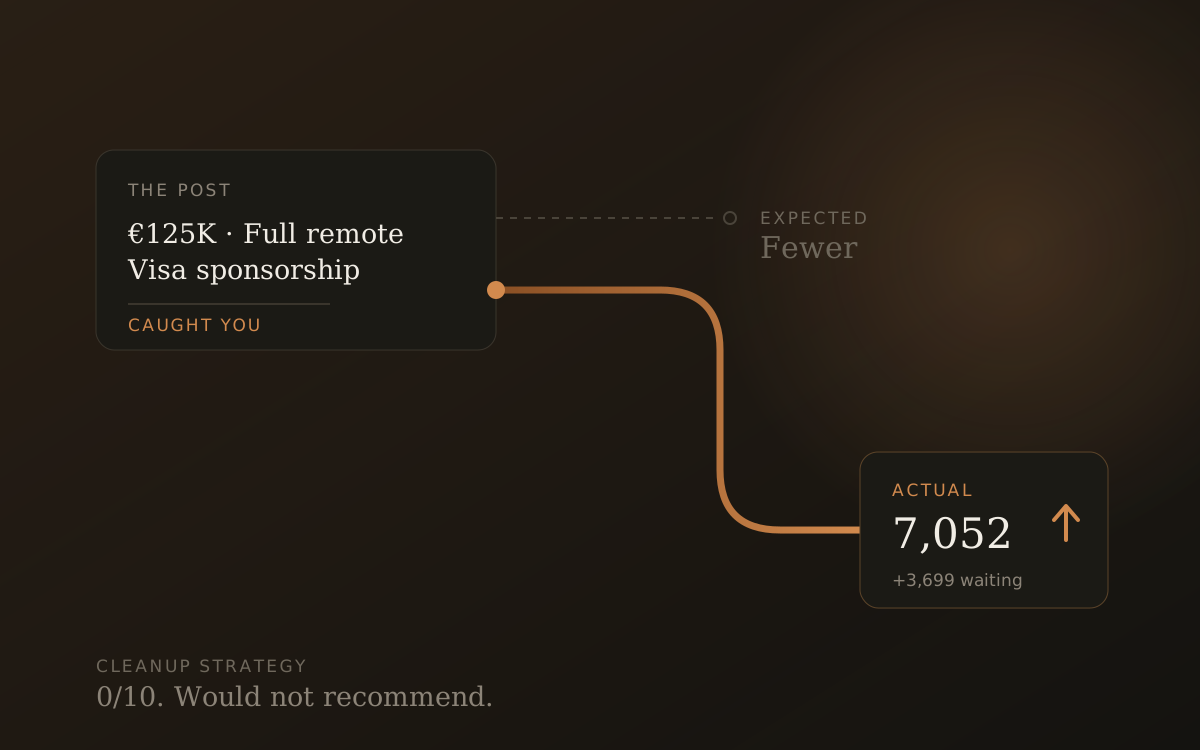
Yesterday I posted this: Senior iOS / Android. €125K. Full remote. Work from anywhere. Visa sponsorship.
Then I left enough empty space for LinkedIn’s “see more” button to do what it does best.
Underneath: Caught you 🪤
And then I explained the whole thing. There was no vacancy. I am not a recruiter. I do not have jobs to hand out. I even asked people to disconnect or unfollow if they had followed me only because they thought I could give them a job.
My expected result was simple: a few people would laugh, some would probably think the post was annoying, and a few of the people who had followed me for the wrong reason would leave. That was the plan.
What actually happened
What happened was the exact opposite.
Connection requests went up. More CVs arrived. Someone commented “I’m interested.”
Someone else dropped a CFBR, which is impressive when you consider they were helping improve the reach of a job that did not exist.
Then people started tagging their friends under the post that explicitly explained there was no vacancy.
That was probably the moment the whole thing stopped being annoying and became funny. Imagine reading there is no job here and thinking: I know exactly who needs to see this.
At that point the cleanup had failed so badly that I started paying attention to what was actually happening.
This is not only a LinkedIn problem
It looked very similar to what happens in real job searches every day.
People see the right technology, a strong salary, remote work, maybe sponsorship, and somewhere in those first few seconds they stop evaluating the role. They start wanting it. That changes the way they read everything that comes after.
A role is remote, but only from one country. Maybe they will make an exception.
It is Staff, but most of your experience is feature delivery and you have never owned the kind of scope the role is asking for. Apply anyway.
The job asks for years of experience with something you have barely touched. Maybe the requirements are just a wishlist.
The company says no sponsorship. Perhaps someone will reconsider once they see the CV.
The problem is not optimism. The problem is that the evaluation has already ended. Once you want the role, every constraint starts looking negotiable.
Then, after 200 applications, the question appears: why is nobody replying?
Sometimes the answer really is the CV. Sometimes the market is bad. Sometimes the hiring process is terrible, the role is stale, or the company already has an internal candidate. All of those things happen.
But there is another explanation that people tend to avoid because it is less comfortable: a meaningful number of those applications may have been weak before anyone opened the CV.
The useful question
That is exactly why I work candidate first.
The useful question is not: where can you apply? You can apply almost anywhere.
The useful question is: where does this company have a credible reason to interview you?
That is a much harder question because it forces you to look at the role from the other side. Not “Do I want this?” and not “Can I technically submit an application?”, but “If I were the hiring manager, what would make this profile worth thirty or sixty minutes of interview time?”
One of the people I worked with, Alexander, followed that process. We aligned his CV and LinkedIn first. Then he applied where the match made sense. According to his verified review, he had his first screening after a week, then technical rounds, a culture-fit interview, and an offer 2.5 weeks after buying the package.
That is not a promise that everyone gets an offer in 2.5 weeks. Hiring does not work like that, and anyone who tells you otherwise is selling certainty they do not have.
What matters is the quality of the search. I have seen the same broader pattern with other candidates too. When the profile becomes clearer and the jobs are selected around the person instead of around a keyword, interviews start appearing where there was previously mostly silence.
That is why I care much more about qualified applications than raw application count. A hundred links are easy. Five roles where I can explain why the candidate belongs in the process are harder. And that is the work.
It is also why I sometimes discount this kind of work. Occasionally I look at a candidate and the problem is obvious: the person is good, but the search around them is terrible. Their profile undersells them, the targeting is wrong, or they are applying in places where the company has almost no reason to look twice. Sometimes I want to help and see what happens when we fix that.
Why the Brief reads the way it does
This whole episode also reminded me why I write The Mobile Career Brief the way I do.
I am not interested in turning “the sun is hot, water is wet” into career advice because a post with 200K impressions made the same obvious point with a nice graphic.
I am writing from 15 years in mobile engineering and 500+ technical interviews from the hiring side. That does not make every opinion universal, and I do not pretend it does. It means the things I write about CVs, seniority, interviews, scope, positioning and job search come from patterns I have seen repeatedly while doing the work.
And no, the Brief is not going to become a free weekly jobs feed either. The value of the roles I find for clients is not that I found a URL they could not have found themselves. The value is that I can explain why I believe that URL belongs to that specific person.
Career OS intake is still paused. The same candidate-first work is available now through Engineer Career Rebuild: I build the profile first, then validate the roles around that person instead of handing over a generic list of jobs. See Engineer Career Rebuild
So, did the cleanup work?
Not even slightly.
I tried to get rid of some of the wrong connections. I ended up with more of them, more CVs, and a noisier inbox.
As a cleanup strategy: 0/10. Would not recommend.
As a small experiment in how people read jobs they badly want? Much more useful.
And apparently I did not learn my lesson
Part 2 is already out. Different salary. Different seniority. Same trap.
Let’s see who reads past the first line this time. 🍿