Interviews
Reading the answer is not the same as giving it.
Most interview preparation stops at recognition. Loops score what you can produce once the question changes. Why I built Interview Runtime, and what it asks you to do.
4 min read
Here is a round I have sat through more times than I can count.
The candidate is prepared. You can tell within two minutes. They know what an actor is, why a main-thread hop matters, what the view model should own. The first answer is clean.
Then I change one thing.
"Fine. Now the user is offline for three days and comes back on a different device."
The answer does not bend. It restarts. The same paragraph comes back with a few words swapped, or it stops halfway and a request for a moment turns into a minute.
In the debrief that round reads as solid, nothing stood out. It is not a fail. It is not a hire either.
The material was there. What was missing was practice at using it.
The first answer is the entry fee
A correct first answer tells the interviewer you did the reading. It does not tell them how you think, because a well-read candidate and a strong engineer give the same first answer.
The score comes from what happens next. The follow-up moves a constraint: more load, a failure, an older OS version, a product manager who wants it next week. Now you have to keep what still holds, drop what does not and say why.
That is the part the loop is built to see. It is also the part most preparation never touches.
Why re-reading feels like progress
Reading an answer you already half know feels productive. Every line makes sense. You nod and turn the page.
That is recognition. The interview asks for production: the answer, out loud, from nothing, in an order that holds together, and then again after someone moves the ground under it.
Recognition grows fast and fades fast. Production grows slowly, and only when you do the uncomfortable thing: answer before you look, then look at what you missed.
Most candidates I see have plenty of the first and very little of the second. Their notes are excellent. Their second answer is not.
What practice has to contain
Strip it down and useful practice has four steps.
Answer first, before you read anything. Out loud or in writing, the way you would say it in the room.
Inspect what was missing. The question is what a strong answer had that yours did not: the trade-off you skipped, the failure you never mentioned, the number you left vague.
Correct it, in your own words.
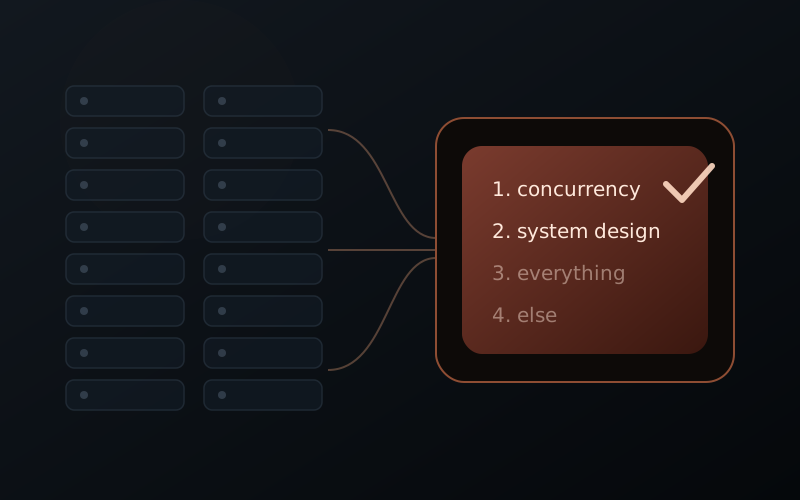
Then answer again under a changed constraint. Same topic, one thing moved. This is the step that turns a memorised paragraph into something you can bend.
And keep the first attempt. Overwrite it and you lose the only evidence that anything changed.
What I built around that loop
That loop is the whole design of Interview Runtime.
It comes as one book per platform, iOS or Android, in PDF and EPUB with companion code. The books carry the material. The dashboard that comes with them carries the practice.
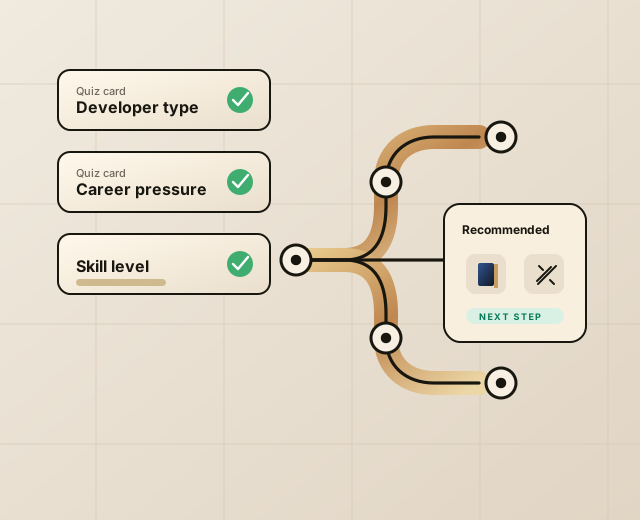
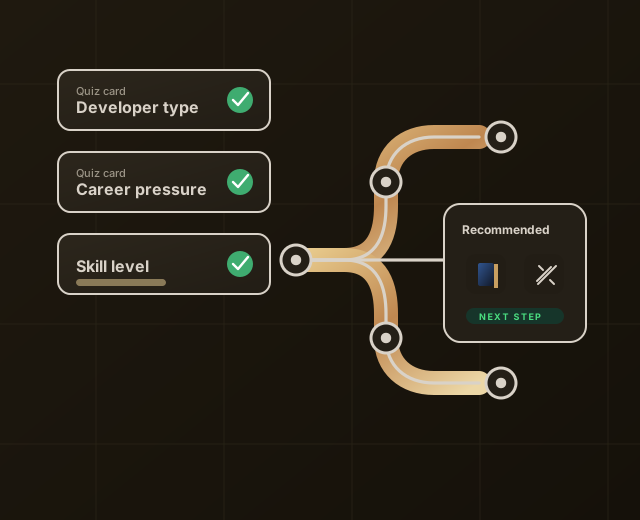
You start with a short brief: the role, the date, what you know about the loop. A baseline shows where your answers are thin, and a 7, 14 or 30-day route starts there.
Each day asks for a piece of work, not a chapter. The day closes when that work exists, not when you opened the page.
Your first attempt is kept as written, next to the retry under a changed constraint, so you see the difference instead of remembering it.
There are 12 simulations per platform. In each one you commit to a decision, and then the pressure changes.
The books sit in the same dashboard with your place kept, so the material is one step away when the practice exposes a gap.
Which one you need
Interview Runtime is for the stage after the reading. If the material itself is still new, start with The iOS interview blueprint, or The senior signal for Android.
If the interview is tomorrow, there is no time for a route. Use the 24-hour iOS or the 24-hour Android answer book. Each one includes a Study Room online, where you answer every card first and then compare with the book.
If you know the material and your second answer is the weak one, that is what Interview Runtime is for. It costs $59 each or $89 for both, a launch price until 31 October, then $99 and $169, and each edition has a free 20-page sample: iOS and Android.
It is interview preparation, not a guarantee of an interview or an offer. What it can do is make your second answer something you have practised, not something you improvise.