Skip to content
All books
Stage 4 Β· Answer practice

The 24-hour iOS interview answer book

157 iOS interview answer cards built for the last day before the loop: the answer, the push that follows, and the line that recovers it.

About the book

This is a fast, practical interview-prep reference for iOS developers who already know how to build apps but need strong answers under pressure.

In 24 hours, you can review the highest-frequency senior iOS topics, memorize clean wording, understand the traps and rehearse how to recover when pushed.

It is the field manual you use when the interview is close: ranked questions, short answers, senior answers, weak answers, interviewer pushes, recovery lines and what earns the point.

What you get

  • The iOS Study Room: all 157 cards online, where you answer first and then compare with the book.
  • The 50 questions most likely to decide your loop
  • The 15 questions that separate senior from mid-level engineers
  • The 10 answers that can cost you the offer, and the 20 that win offers
  • Every card: short answer, senior answer, why they ask, the trap, the interviewer push and the recovery line
  • 5 full interview simulations with scoring rubrics
  • A 2-hour crash path, company-specific paths and a final 30-minute review checklist

Included with the book

The iOS Study Room

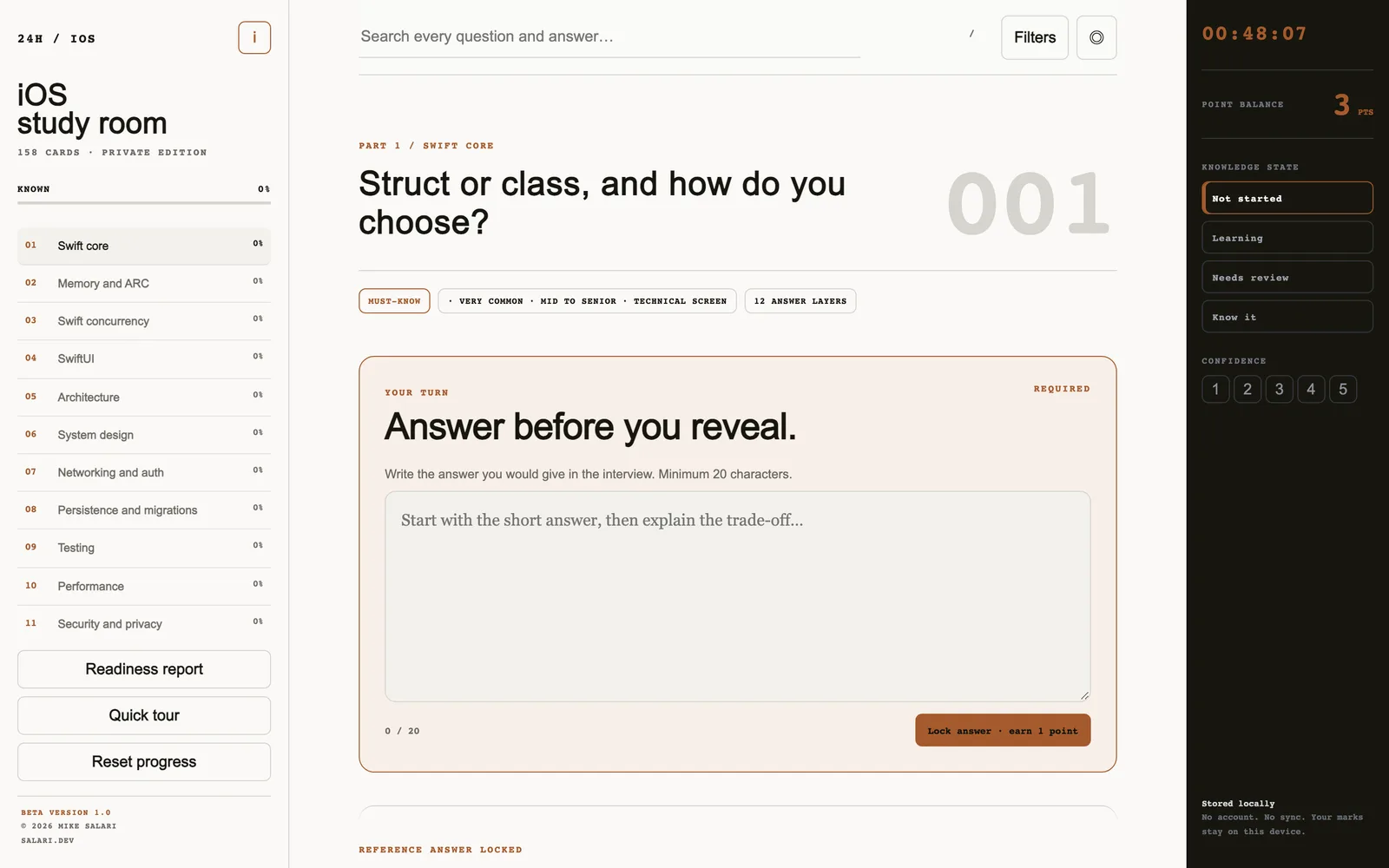
All 157 cards, online, in a private room for your edition. You write the answer you would give aloud before the book's answer appears, then mark what you know and how sure you are. At the end, a readiness report shows which topics hold and which still need work.

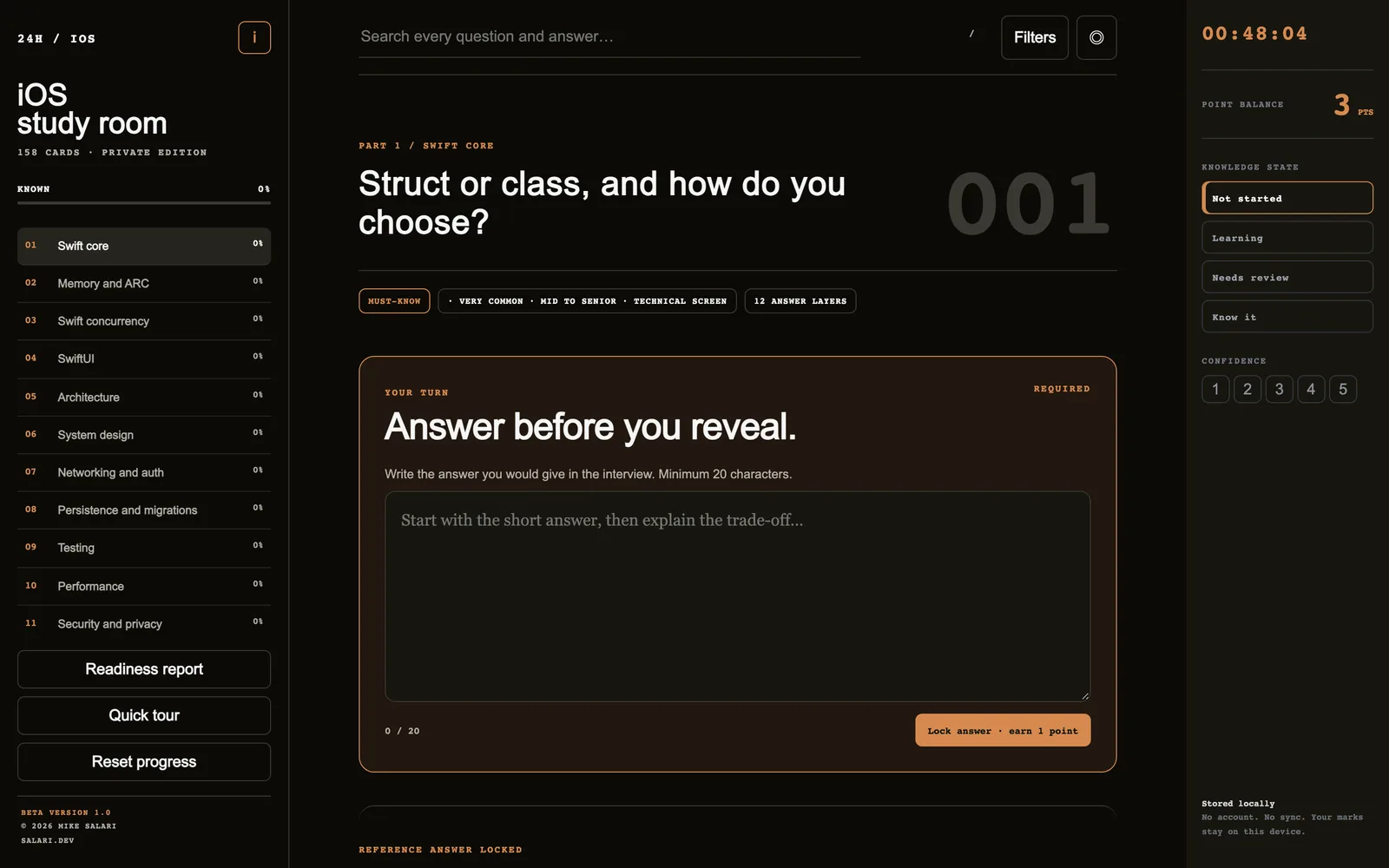
The iOS Study Room: the first card, with the answer box open before the book's answer appears
Inside the iOS Study Room. You write your answer first; the book's answer stays locked until you do.
  • Answer firstThe book's answer stays hidden until you have written yours.
  • Search every cardEvery question and every answer layer, searchable from one field.
  • Readiness by topicWhat is ready and what still needs work, topic by topic.
Open the Study Room

Already own it? Use the purchase code from your receipt.

A page from the book

Copied as printed, so you can judge the format before you buy.

Part 3, Swift concurrency, pages 65 to 66

How does task cancellation work?

Must-know Β· Very common Β· Senior Β· Technical screen

Short answer

Cancellation is cooperative. The runtime marks a task cancelled, but your code must notice, by checking Task.isCancelled or calling try Task.checkCancellation() in long loops, and you let CancellationError propagate.

Senior answer

Marking a task cancelled does not stop it; it sets a flag and cancels child tasks. Well-behaved async APIs check the flag at suspension points, which is why structured tasks feel like they β€œjust cancel,” but your own loops must check explicitly. For bridged work, withTaskCancellationHandler lets you tear down a resource the moment cancellation arrives. The common bug is swallowing CancellationError in a generic catch, which hides the cancellation from the caller.

Why they ask

To confirm you know cancellation is not automatic for your own code.

Common trap

Assuming cancel() halts work, or catching and discarding CancellationError.

Code

Swift
for item in items {
    try Task.checkCancellation()            // stop promptly if cancelled
    await process(item)
}

Live interview wording

β€œCancellation is cooperative: the runtime flags the task, but my loops have to check isCancelled or call checkCancellation, and I let CancellationError propagate rather than swallowing it.”

Weak answer

β€œI call cancel() and the task stops.”

Interviewer push

β€œIt kept running after cancel(). Why?”

Recovery line

β€œCancellation is cooperative. cancel() sets a flag; my code has to check Task.isCancelled or call checkCancellation in the loop. A long loop that never checks runs to completion.”

What earns the point

Knowing cancellation is cooperative and your code must check it.

Want more pages?

Before and after

Swift concurrency

Before

Actors make code thread-safe.

After

Actors protect isolated mutable state, but they do not make every interaction automatically safe.

I would still reason about reentrancy, Sendable boundaries and cancellation.

SwiftUI state

Before

Use StateObject for view models.

After

I choose the wrapper based on ownership.

If the view creates and owns the object, StateObject is appropriate. If it receives it, ObservedObject or environment-style injection is usually cleaner.

What is inside

  1. The Top 50 Questions That Decide the Loopp. 11
  2. The 15 Questions That Separate Senior From Mid-Levelp. 14
  3. The 10 Answers That Can Cost You the Offerp. 16
  4. The 20 Answers That Win Offersp. 17
  5. How Interviewers Push, and How to Recoverp. 20
  6. What Interviewers Are Actually Looking Forp. 21
  7. 2026 updates worth knowingp. 24
  8. Part 1: Swift corep. 26
  9. Part 2: Memory and ARCp. 46
  10. Part 3: Swift concurrencyp. 54
  11. Part 4: SwiftUIp. 74
  12. Part 5: Architecturep. 90
  13. Part 6: System designp. 106
  14. Part 7: Networking and authp. 126
  15. Part 8: Persistence and migrationsp. 136
  16. Part 9: Testingp. 145
  17. Part 10: Performancep. 154
  18. Part 11: Security and privacyp. 164
  19. Part 12: Accessibility and localizationp. 173
  20. Part 13: CI/CD, code signing, and releasep. 179
  21. Part 14: Live coding drillsp. 185
  22. Part 15: Behavioral answersp. 200
  23. Part 16: Management and leadershipp. 210
  24. Company Answers: Bad, Good, Greatp. 218
  25. Real Mistakes I Have Seenp. 220
  26. Live interview simulationsp. 222
  27. Senior Interview Readiness Scorecardp. 238
  28. Final 30-minute reviewp. 240
  29. Appendix: Bonus topicsp. 244
  30. Appendix: Technical notes and sourcesp. 245

What readers say

  • β€œA professionally written and genuinely useful book. It’s not just something to pick up when you need to quickly prepare for a technical interview β€” it’s a great resource to revisit from time to time to refresh your knowledge and reinforce key concepts. Clear, practical, and worth keeping within reach. Highly recommended.”

    Olha B.
    Gumroad verified purchase
  • β€œI came to this book after reading iOS Blueprint and following Mike's advice. Honestly, this book helped me a lot. I had an interview this Monday and only had the weekend to refresh my knowledge. The technical round went well, and I was able to answer almost all of the questions confidently. The only area where I got stuck was explaining Sendable, which showed me where I still need more practice. The next book I'll probably buy is Share Your Screen, especially for the live coding preparation. Mike's approach is very clear, detailed, and easy to follow. The explanations focus on helping you truly understand the concepts rather than just memorizing answers. Thanks a lot for creating these resources, they were genuinely helpful during my interview preparation πŸ‘Œβ€

    Elena A.
    Gumroad verified purchase
  • β€œAmazing book”

    Andrey Sam.
    Gumroad verified purchase
Show all 7 reviews
  • β€œThe interview doesn't start when they ask the question. It starts when they challenge your answer. I kept preparing definitions; interviewers kept asking about trade-offs and failure modes. For the first time in years, I walked in prepared for the conversation, not just the questions.”

    Mark, Staff Mobile Engineer Β· 11 years
    Early reader
  • β€œThe cards are about a page each but cover exactly what interviewers ask. I read the token-refresh section the night before and got almost that exact discussion in the loop.”

    Ahmed, Mobile Engineer Β· 7 years
    Early reader
  • β€œInstead of saying 'I'd use MVVM,' I started explaining why I'd choose it and when I wouldn't. That changed the entire conversation in my interviews.”

    Rosa, iOS Engineer Β· 4 years
    Early reader
  • β€œThe hardest part was knowing how much detail to give. The short answers and live wording finally gave me a structure instead of talking until I ran out of ideas.”

    Kevin, iOS Engineer Β· 2 years
    Early reader

Reader reviews from Gumroad, and early readers who were given a copy before release.

Who this is for

This is for you ifYour iOS interview is close enough that triage matters more than complete coverage.

  • Mid-Level iOS Engineer
  • Senior iOS Engineer
  • Lead Candidate
  • Staff Candidate
  • Interview in 24-72 hours

Not for

  • Are still learning beginner iOS
  • Need a full Swift tutorial
  • Want theory without interview practice
The library pathWhere this fits
  1. 01Get foundThe Silent Rejection
  2. 02Build the record and negotiateThe iOS Engineer Playbook Β· Leverage
  3. 03InterviewThe iOS interview blueprint Β· The senior signal Β· Top 300 React Native interview questions Β· 500 Flutter interview questions Β· The senior SDET interview handbook
  4. 04Answer practice and live roundsThe 24-hour iOS interview answer book Β· The 24-hour Android interview answer book Β· Share your screenYou are here
  5. 05Architecture and qualitySwiftUI under load Β· Mobile System Design blueprint Β· Security is a feature Β· The Second Pass
  6. 06Staff systems and ownershipAltitude Β· Ticket taker, outcome owner
  7. 07Build with AIBuild with your brain on (coming soon)
  8. 08LeadLeadership blueprint (coming soon)
  9. 09ArchitectArchitect blueprint (coming soon)
Portrait of Mike Salari

About the author

Mike Salari

Staff mobile engineer Β· 500+ technical interviews from the hiring side.

I wrote this for the last-mile pressure of senior iOS interviews, where wording, tradeoffs and recovery matter as much as raw knowledge.

15 years building production mobile software, with experience across Apple, Adobe, Cisco, Mastercard and Visa.

Read the full story

Before or after you buy

Share this book