Career strategy
The two documents that decide your career are written by other people
One gets written after your interview. The other gets written after your offer. You never see either, and that is exactly why they cost you money.
4 min read
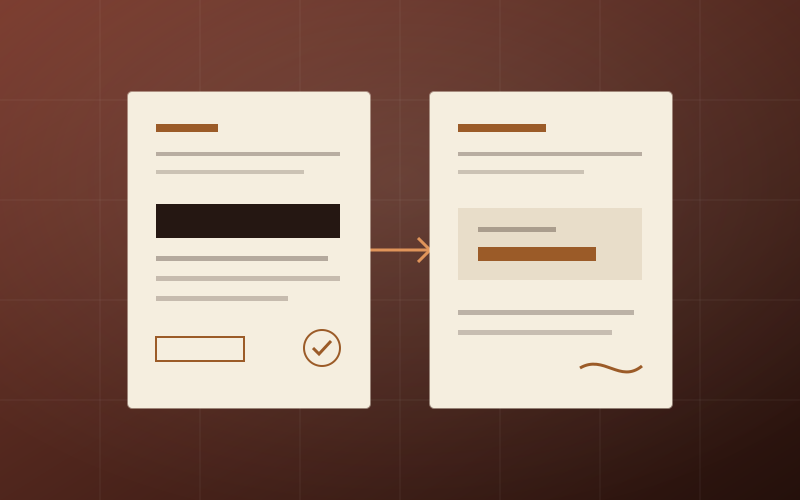
There is a document that exists about you and you have never read it.
When you interview at a serious company, a packet gets written. Someone types up a verdict, the evidence for it, the doubts, and the sentence that gets said about you in the room when you are not there. Then a decision happens, and all you receive is the output: an offer, or a template rejection wishing you luck.
I have spent fifteen years on the hiring side of that table as a staff engineer and tech lead, reading CVs by the hundred and writing my share of those packets. And here is the uncomfortable part: most engineers lose the decision before the interview even starts, in the first ten seconds of a document they wrote themselves.
What the packet actually says
Two weeks ago I did something backwards: I wrote one of those packets FOR the candidate instead of about him.
A senior Android engineer bought my audit. Eleven shipped apps. Two production digital wallets. A payments platform with half a million downloads. A team of three reporting to him. On paper, the kind of engineer companies say they cannot find.
He was getting zero recruiter responses.
The packet I wrote him opened with a verdict, the same way a real one would: strong inventory, invisible storefront. His CV named not a single one of his eleven products. His headline claimed a technology his experience never mentioned. His most valuable specialization, payments, sat buried in a skills list between Google Maps and MATLAB. His LinkedIn ended by asking for the one thing contract clients never sell: an opportunity to grow.
None of that is a skills problem. Every finding had a fix, and every fix was mechanical: name the products, attach the numbers, lead with the specialization, delete the claims you cannot defend. He applied the entire rebuild within two days of reading it.
The lesson that transfers to you costs nothing: read your own CV the way a committee does. First ten seconds only. If a stranger cannot answer what you own, what it is worth, and why you over the next person, the rest of the document never gets read, and the packet writes itself without you.
The second document: one reply before the number sets
Suppose the first document goes your way. An offer lands in your inbox. Here is the moment almost everyone gets wrong, and it is the most expensive sentence in your career.
The number in that offer is not final. Everyone involved knows it is not final. But it becomes final the moment you answer wrong, and the two wrong answers are the two most common ones: accepting within a day because you are relieved, or getting on a phone call to discuss it.
Never negotiate on a call. A call is where enthusiasm gets read as acceptance, where a range you mention becomes your ceiling, and where the first person to speak after a number loses. Negotiation happens in writing, once, with evidence.
A proper counter is one email. It thanks precisely, it names one number, it stands that number on market evidence rather than on feelings, and then it stops talking. No apology, no essay, no it depends. The silence after the number is not rudeness, it is the mechanism. And behind that email sits a fallback you decided in advance: what you say to the first no, what you trade instead of salary, and where your floor is, so no phone call can improvise it away from you.
One reply, done correctly, moves an offer by five to fifteen thousand. I have watched candidates leave exactly that on the table by replying in one day with the wrong sentence, and the company never tells you. Why would they? The packet stays closed, the number stays low, and everyone smiles at onboarding.
Write the documents before they write you
Both documents obey the same rule: they get written whether you participate or not. The packet gets written from whatever your CV and profile hand the committee. The final number gets set by whatever your first reply hands the recruiter. Participation is optional; consequences are not.
So participate. Rewrite your first ten seconds until they answer the committee's three questions. Decide your counter and your floor before the offer arrives, not after. Do it yourself with the ideas above, they are free and they work.
And if you want it done for your exact situation, this is what I do. The Engineering CV Audit is the packet written for you instead of about you: verdict, findings, fixes, your CV rebuilt, your positioning and rate plan, delivered in 48 hours, no calls. Current availability and pricing live on Gumroad: View the Engineering CV Audit
The Written Offer Counter Pack is the second document: your counter email written for your exact offer, the market evidence behind it, and the fallback script, in 48 hours, for the week an offer is sitting in your inbox. Current availability and pricing live on Gumroad: View the Written Offer Counter Pack
Both are blunt by design. An audit that only compliments you would be a waste of your money, and a counter that apologizes is not a counter.
The documents are getting written either way. The only question is who holds the pen.
Where this fits
This essay belongs to the Get Hired path: Resume, LinkedIn, referrals, recruiter signal, negotiation and first-90-days systems.